
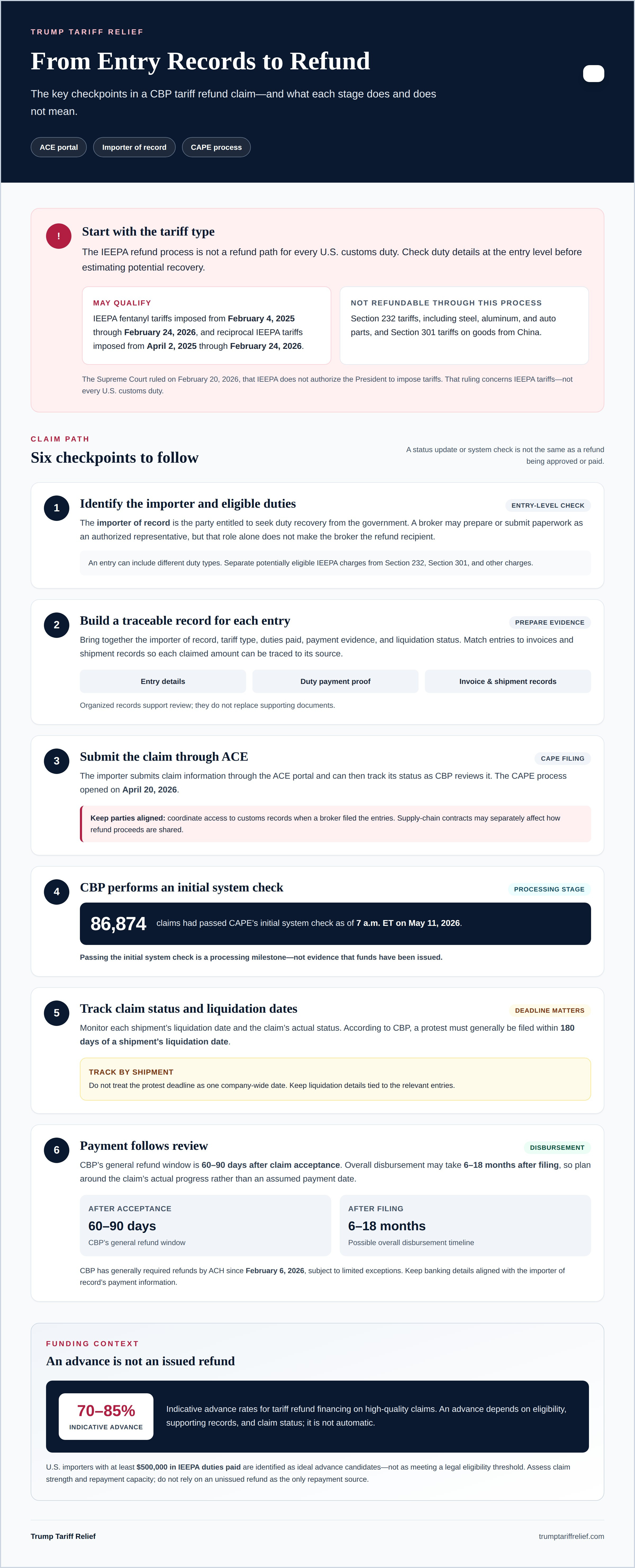
Not every tariff can be reclaimed, and the distinction matters before an importer counts on cash from a claim. IEEPA fentanyl tariffs imposed from February 4, 2025, through February 24, 2026, and reciprocal IEEPA tariffs imposed from April 2, 2025, through February 24, 2026, may qualify for refunds; Section 232 and Section 301 tariffs aren’t refundable through the IEEPA process. For high-quality claims, indicative advance rates for tariff refund financing for importers are 70-85%.
If you’ve paid eligible duties, the next challenge is turning a potential refund into a claim that can be reviewed and, for qualifying claims, potentially funded. Any advance depends on factors such as eligibility, supporting records, and claim status, so it is not automatic.
This guide explains which tariffs may qualify, how claims move through the refund process, what documentation supports them, and what can affect an advance rate. You’ll come away with a clearer view of whether your imports fit the process and what happens next.
Key Takeaways
- Separate potentially eligible duties from other tariff categories before estimating recoverable funds.
- Organize entry, payment, and shipment records so each claim can be traced and supported.
- Track liquidation and filing milestones carefully, since timing can affect the options available for a refund claim.
- Assess an advance against claim strength and repayment capacity, rather than relying on an unissued refund as the only source of repayment.
Which Tariffs Are and Are Not Refundable?
On February 20, 2026, the Supreme Court of the United States ruled that the International Emergency Economic Powers Act does not authorize the President to impose tariffs. That ruling concerns IEEPA tariffs, not every U.S. customs duty. Importers should identify the tariff program attached to each entry before estimating potential recovery.
IEEPA duties may qualify for the refund process. By contrast, Section 232 tariffs on steel, aluminum, and auto parts, and Section 301 tariffs on goods from China, are not refundable through that IEEPA process. A shipment can carry different duty types, so an eligible IEEPA charge does not make every tariff on the entry refundable. Review duty details at the entry level.
The importer of record is the party entitled to seek duty recovery from the government. A customs broker may prepare or submit paperwork as an authorized representative, but that role alone does not make the broker the refund recipient. If a broker filed entries for your business, identify the importer of record on those entries and coordinate access to the customs records. Contracts may separately affect how supply-chain parties share proceeds.
Import history establishes whether duties were paid under a potentially eligible program. Match entry records to duty statements and payment evidence, then separate IEEPA charges from excluded tariffs. U.S. importers with at least $500,000 in IEEPA duties paid are identified as ideal advance candidates, not as meeting a legal eligibility threshold. Lower duty exposure does not by itself establish that a refund claim qualifies.
Tariff refund financing advances funds against a potential recovery tied to an eligible claim. A customs drawback broker works on a distinct drawback process, while a traditional business loan relies on its own repayment terms rather than a particular tariff refund. Compare the underlying claim, documentation, and repayment structure before treating either source as working capital.
Automation and recordkeeping for refund claims
Organized records can make a large claim set easier to review, but they cannot replace supporting documents. Build a consistent record for each customs entry: importer of record, tariff type, duties paid, payment evidence, and liquidation status. Match entries to invoices and shipment records so each amount can be traced to its source. Separate potentially eligible IEEPA duties from other charges before totaling claims.
Administrative work follows a clear sequence: assemble entry-level records, confirm the claim basis, submit through the applicable CBP process, and monitor status. CBP’s claim process uses the ACE portal, and refunds have generally been required by ACH since February 6, 2026, subject to limited exceptions. Keep banking details aligned with the importer of record’s payment information. A mismatch can slow administration even when the supporting record is complete.
Pending-refund financing can take the form of an advance against a claim or a conventional business loan. Trade finance firms and specialty finance providers may consider advances; banks and other lenders may offer credit based on broader business repayment capacity. The structure matters: an advance tied to a refund depends heavily on claim documentation, while a loan can create repayment obligations independent of refund timing.
No specific lender names are established here. In general, importers can explore trade finance providers that assess refund claims, alongside lenders evaluating ordinary business credit. Eligibility reviews commonly focus on importer-of-record status, entry and duty-payment records, claim documentation, liquidation details, and the strength of the repayment source.
If a refund claim is being purchased or transferred, due diligence should include the seller’s supply-chain contracts. Those agreements can clarify who paid duties and whether another party may claim a share of proceeds. Keep contract versions and supporting records together. A structured tariff refund claim process connects documentation, filing, and status tracking without treating a projected recovery as cash already received.
Refund processing through CBP or official channels
CBP’s CAPE process moves refund claims through filing, system review, and payment stages. The importer of record remains central to the government filing, even when other supply-chain parties have a financial interest.
Application and Review Steps
For CAPE filing, the importer submits claim information through the ACE portal, then tracks its status as CBP reviews it. The process opened on April 20, 2026. As of 7 a.m. ET on May 11, 2026, 86,874 claims had passed CAPE’s initial system check. That check is a processing stage, not evidence that funds have been issued.
Organize entry details and duty records so the submitted claim can be reconciled with the importer of record. CBP’s general refund window is 60-90 days after claim acceptance. Overall disbursement may take 6-18 months after filing, so businesses should plan funding around the claim’s actual status.
Claim Deadlines and Time Limits
According to U.S. Customs and Border Protection, a protest must generally be filed within 180 days of a shipment's liquidation date. Liquidation is therefore a key date for entries that may require a protest; filing deadlines should be tracked by shipment, not treated as one company-wide date.
Supply-chain contracts also matter. The importer of record seeks duty recovery from the government, while private agreements may determine whether another party receives a share of proceeds. Review those agreements before filing or arranging financing, and align the claim, payment records, and any proceeds-sharing terms.
Keep refund proceeds distinct from projected cash. CBP generally requires refunds by ACH, subject to limited exceptions, and CBP charges no fee to process refunds. Because payment follows review, do not treat a pending claim as received funding. Monitor the claim’s status and preserve filing records to support follow-up if it remains in process.
What advance rate can I expect on my claim?
High-quality tariff refund claims have an indicative advance rate of 70-85%. For tariff refund financing for importers, the amount offered depends on the claim’s eligibility, entry-level records, duty-payment evidence, liquidation status, and expected path through the refund process. A funding provider also weighs how much of the claim is supported and how repayment will work.
An advance may provide working capital before CBP disburses a refund. Plan its use around existing cash needs, such as inventory purchases or supplier payments, rather than treating expected proceeds as cash already received. Repayment depends on the agreement: it may come from recovered proceeds, while a loan may require payments under separate terms.
Build a repayment plan that still works if processing takes longer than expected. Keep a cash-flow forecast that separates pending refund proceeds from operating cash and identifies another repayment source. This reduces dependence on a claim whose status may change during government review. Avoid pledging the same expected refund to multiple financing arrangements.
The Supreme Court ruling does not itself put refund money in an importer’s account. A claim must still go through official review, and timing affects when proceeds can support debt repayment or rebuild working capital. If an appeal or other dispute affects a claim, map the repayment schedule to the actual claim status, not an assumed payment date.
The cost of financing depends on the case and the terms offered. Consider the claim’s documentation, advance amount, expected duration, and repayment structure. Compare the total repayment obligation and any stated fees or interest with the funds available after repayment, not just the headline advance rate. These are core considerations in tariff refund financing for importers.
Before committing expected proceeds, use the tariff refund financing FAQs to clarify how claim status and repayment planning fit together.
Trump Tariff Relief: IEEPA Tariff Refund Recovery
Trump Tariff Relief helps importers assess potential IEEPA refund eligibility, organize customs records, and manage recovery filings. Its Tariff Eligibility Assessment and Customs Documentation Management help clarify whether paid duties and entry records support pursuing a claim.
For businesses weighing an advance against a pending refund, first understand the claim’s eligibility and documentation before relying on expected proceeds. Trump Tariff Relief manages IEEPA Tariff Refund Recovery on a contingency-fee basis: there are no upfront costs, and clients pay only a percentage of funds successfully recovered. The team manages the process from assessment and documentation through government filings. A refund outcome is not guaranteed.
Contact Trump Tariff Relief to discuss your potential IEEPA tariff refund claim.
Turn a Potential Recovery Into a Clear Next Step
A sound approach to tariff refund financing for importers starts with deciding how a potential recovery fits your company’s broader financial plan. Bring treasury, customs, and operations teams into the conversation early. They can align claim records with cash-flow planning, identify who needs to approve financing terms, and decide how recovered funds would support the business.
Keep the distinction clear: a projected refund is not available cash. Base decisions on the claim’s documented status and repayment terms, rather than using expected proceeds to make commitments the business cannot otherwise support. This helps protect operational flexibility while the claim moves through the process.
If you want support assessing a potential claim and its next steps, start a conversation with Trump Tariff Relief. A focused discussion can help you determine what to prepare and how to move forward with greater clarity.
Frequently Asked Questions
How can I prepare for a potential refund of IEEPA duties?
Prepare your company details, estimated IEEPA duties paid, import regions, and an inventory of available records. Entry summaries, commercial invoices, transportation documents, and duty statements can help connect payments to specific imports. Organize information by entry so gaps are easier to identify. Trump Tariff Relief keeps business information strictly confidential and does not share it without explicit consent.
How long does the advance process take?
The timing of an advance depends on claim review, documentation, and the funding arrangement. Trump Tariff Relief provides an initial eligibility response within one business day, while the full assessment timeline varies with case complexity. An eligibility response is not a funding date: advanced funding is available for qualifying claims, and records and claim status affect the process. Plan cash needs without treating expected funds as already available.
What happens when CBP disburses the refund?
CBP pays refunds through its official process, and the importer of record receives the government duty recovery. If you received an advance, the financing agreement determines how proceeds are applied, including whether repayment is deducted from the refund or handled separately. Reconcile the disbursement against the claim and agreement, then record any remaining proceeds for working capital or other planned uses.
What tariff refunds can U.S. importers claim, and which duties are eligible?
Potential refunds concern qualifying IEEPA duties, including fentanyl tariffs imposed from February 4, 2025, through February 24, 2026, and reciprocal IEEPA tariffs imposed from April 2, 2025, through February 24, 2026. Section 232 and Section 301 duties aren’t refundable through the IEEPA process. Eligibility depends on the importer’s entry history, duty payments, and claim documentation.
How do importers file a U.S. customs duty refund or drawback claim?
For an IEEPA refund, the importer of record submits the claim through the applicable CBP process, supported by entry and payment records. The appropriate filing instrument can depend on the entry’s status. A drawback claim is a distinct customs procedure, not another name for an IEEPA refund. A customs broker may assist with filings, but the importer of record remains the government refund recipient.
What risks arise if a tariff refund claim is delayed, reduced, or denied after financing?
A delayed claim can leave an importer waiting for proceeds while financing obligations continue under the agreement. If CBP reduces or denies recovery, the refund may not cover the expected repayment amount. Before accepting an advance, identify whether repayment depends only on recovered proceeds or whether other repayment obligations apply. Also model cash flow without the expected refund so essential supplier payments and inventory commitments remain manageable.
Ready to find out what your business may be owed?
Check My Eligibility