Did you know that the U.S. Treasury is currently holding a $166 billion pool of invalidated tariff duties that belongs back in the hands of American importers? You've likely felt the weight of these capital-draining payments for years, watching your margins shrink while struggling with the complex filing requirements of Customs and Border Protection. It's exhausting to manage these overhead costs, particularly when a strict three-year statute of limitations means your window to reclaim those funds is rapidly closing. Our free tariff eligibility assessment offers the professional certainty you need to identify if your business qualifies for a significant IEEPA refund without any financial risk.
If your company imported goods under the now-invalidated IEEPA authority, you deserve a clear path to financial restoration. We'll provide a definitive "yes" or "no" on your legal status, calculate the estimated dollar value of your potential recovery, and outline a streamlined, hands-off path to reclaiming your capital. This guide explores the recent Supreme Court ruling that triggered this massive refund opportunity and explains how our expert-led process moves the burden of recovery from your desk to ours.
Key Takeaways
- Learn why the 2026 Supreme Court ruling on IEEPA tariffs has unlocked a $166 billion refund pool for eligible importers.
- Understand how a technical analysis of your Harmonized Tariff Schedule (HTS) codes can pinpoint precisely which past duties are now legally recoverable.
- Discover why standard customs brokers often overlook these specialized refund opportunities and how a free tariff eligibility assessment bridges that gap.
- Identify the four critical data points, including your Importer of Record numbers, required to initiate a comprehensive audit of your trade history.
- Explore our risk-free, contingency-based recovery model that ensures our interests are fully aligned with maximizing your capital restoration.
The $170 Billion Opportunity: Why a Free Tariff Eligibility Assessment is Critical in 2026
The U.S. trade landscape shifted permanently in February 2026 when the Supreme Court affirmed that billions in duties were collected without proper legal standing. This wasn't a minor administrative error; it was a systemic overreach that left approximately $166 billion of private capital sitting in federal accounts. For importers who've spent years navigating aggressive trade wars, this court-ordered restoration represents a rare opportunity to recover significant liquidity. Moving from a "potential" claimant to a verified recipient requires a precise diagnostic, which is why a free tariff eligibility assessment has become the essential first step for any business that imported goods under recent Section 301 actions.
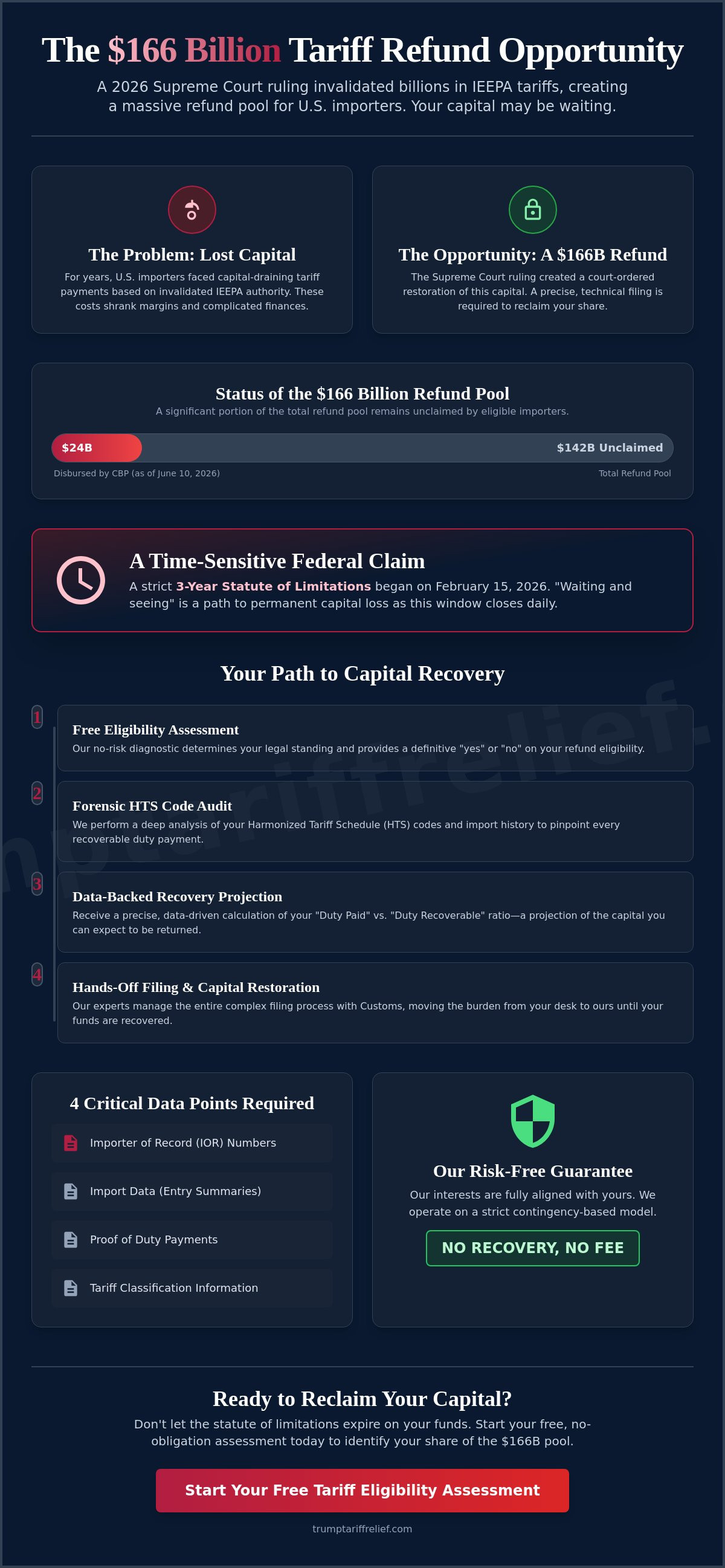
By June 10, 2026, U.S. Customs and Border Protection (CBP) had already sent nearly $24 billion in refunds to the Treasury Department for disbursement. However, a massive portion of the $166 billion total remains unclaimed or tied up in legal disputes. This capital isn't distributed automatically. It requires a proactive, technical filing that matches your specific import history against the invalidated lists. Without a professional audit, your business risks leaving its share of this multi-billion dollar pool on the table while competitors reclaim their margins.
The Legal Catalyst: Understanding the IEEPA Ruling
The core of this opportunity lies in the International Emergency Economic Powers Act (IEEPA). While this act grants the President broad authority during national emergencies, the courts determined in early 2026 that this power doesn't extend to the indefinite imposition of specific trade duties without Congressional oversight. It's vital to distinguish this from "duty drawback," which is a standard administrative process for exported goods. These IEEPA refunds are a legal correction of a regulatory wrong, aimed specifically at restoring funds taken through invalidated Section 301 lists. You can find a deeper dive into the specific legal precedents on our page regarding the IEEPA explained.
The Time-Sensitive Nature of Federal Claims
On February 15, 2026, the Supreme Court finalized the ruling that invalidated these specific tariff lists, effectively starting a countdown for every American importer. Federal law mandates a strict three-year statute of limitations for these claims. If you don't file within this window, your right to that capital expires permanently. Every day your funds remain with the Treasury is a day they aren't working for your business. A free tariff eligibility assessment ensures you don't miss this fleeting window due to administrative delay or internal uncertainty. "Waiting and seeing" isn't a strategy; it's a path toward permanent capital loss as the statute of limitations steadily closes on your eligible entries.
Anatomy of an IEEPA Assessment: How We Identify Your Refund Potential
Identifying your share of the $166 billion refund pool requires more than a casual glance at your accounting software. It demands a forensic audit of your entire "Importer of Record" (IOR) history to pinpoint every transaction affected by the invalidated IEEPA authority. Our free tariff eligibility assessment functions as a technical diagnostic. It sifts through years of trade data to isolate specific duties that are now legally eligible for restoration. We don't just look for general imports; we verify the precise intersection of origin, timing, and HTS classification. This process ensures that every dollar you paid under the invalidated lists is accounted for before we move to the filing stage.
The assessment concludes with a precise calculation of your "Duty Paid" versus "Duty Recoverable" ratio. This isn't a ballpark estimate or a vague range. It's a data-backed projection of the actual capital you can expect to see returned to your business. If you're curious about the specific steps our team takes to secure these funds, you can see how the recovery process works in detail.
HTS Code Verification: The Core of Eligibility
Not all goods originating from China qualify for a refund under the 2026 ruling. The legal invalidation specifically targets items found on List 3 and List 4A. During the Four-Year Review of Section 301 Actions, the government established rigorous standards for which products remained subject to duties. Our free tariff eligibility assessment cross-references your Harmonized Tariff Schedule (HTS) codes against these specific federal lists to ensure absolute accuracy. Often, we identify "misclassified" entries where goods were categorized under codes that didn't receive relief, even though they technically qualified. Correcting these clerical errors can significantly increase your total recovery value.
Entry Status and Liquidation Timelines
Customs terminology is a maze. A critical part of our audit involves verifying the "Entry Status" of your shipments. Liquidation is the final stage of a customs entry where CBP closes the file and fixes the duty amount. If an entry is "unliquidated," it means the file is still open, providing a much faster path to cash recovery. Liquidated entries represent a different challenge, often requiring formal protests. Our experts navigate the Automated Commercial Environment (ACE) data to find hidden opportunities in your filing history that internal accounting teams typically miss. We track these timelines aggressively to ensure no entry falls outside the three-year statute of limitations.
The High Cost of DIY: Why Internal Audits Miss Section 301 Recoveries
Importers often assume their existing customs broker or internal accounting department has already flagged every available refund. This assumption is a costly mistake that leaves significant capital sitting in federal accounts. The reality is that internal teams are typically optimized for day-to-day operations and general financial reporting, not the high-stakes, technical world of trade litigation recovery. Relying on a standard audit often leads to "Partial Filing," a scenario where a business leaves 40-50% of its eligible refund on the table because of incomplete data extraction or a lack of specialized trade law expertise. A free tariff eligibility assessment acts as a necessary safeguard, providing a level of forensic scrutiny that internal reviews simply cannot match.
Our role isn't to replace your current team but to serve as a high-performing partner that takes on the heavy lifting of federal recovery. While your accountants manage the balance sheet, we navigate the bureaucratic maze of Customs and Border Protection (CBP) to right the financial wrong of overpaid duties. Professional verification typically uncovers 20% more recoverable capital than internal reviews. If you have questions about how our specialized recovery efforts integrate with your existing workflows, you can find more details in our FAQ.
Broker vs. Recovery Specialist: Knowing the Difference
It's vital to understand that customs brokers handle the "inbound" flow; we handle the "backward" recovery. A broker's primary objective is compliance and the seamless movement of goods across borders. They are rarely incentivized to conduct the deep, historic audits required for IEEPA claims. In many cases, your broker might not even be aware of the specific protest requirements triggered by the 2026 ruling. This need for specialized knowledge mirrors other technical industries; for instance, TSIAC International provides the necessary expert oversight for demolition and abatement projects that general contractors might overlook. Furthermore, a natural conflict of interest exists; brokers are often hesitant to admit that previous classification errors occurred under their supervision, even if those errors now represent a massive refund opportunity.
Avoiding the "Incomplete Claim" Trap
Self-assessment often leads to the "Incomplete Claim" trap, where entries are rejected by CBP due to technical filing errors or missing documentation. The recovery process requires sophisticated "unstacking" of provisions, particularly when dealing with complex trade remedies that overlap across different Section 301 lists. Without an expert-led free tariff eligibility assessment, businesses frequently miss entries that were misclassified or liquidated under the wrong authority. We use advanced diagnostic tools to ensure every eligible entry is captured, moving your claim from a simple internal estimate to a legally robust filing that maximizes your total recovery.
Preparing for Your Assessment: 4 Essential Data Points You Need
Initiating a free tariff eligibility assessment doesn't require weeks of administrative preparation or a total restructuring of your trade department. It's a streamlined, professional diagnostic designed to identify overpaid duties with surgical precision. To move from curiosity to a filed claim, we require four specific pillars of data. These allow our team to cross-reference your trade history against the $166 billion refund pool. By centralizing this information now, you ensure the audit is both exhaustive and accurate, preventing any eligible entries from slipping through the bureaucratic cracks.
While the recovery process itself is hands-off for your team, the quality of the initial diagnostic depends on the data provided. We focus on the last three to five years of your import history to ensure we capture every entry that remains within the statute of limitations. This proactive approach is the only way to safeguard your capital before it's permanently absorbed by the federal treasury.
Step 1: Gathering Your IOR Numbers
Every business entity that acts as an Importer of Record has a unique identifier used by Customs and Border Protection. If your organization operates through multiple subsidiaries or has a complex parent company structure, each entity must be assessed individually to capture the full scope of your potential refund. It's common for large importers to lose track of specific IORs used for niche product lines or seasonal China imports. We need every active number used over the last five years to guarantee a comprehensive review. You can check how it works for a complete checklist of the entity information required to begin.
Step 2: Exporting ACE Portal Data
The Automated Commercial Environment (ACE) portal is the primary source of truth for your trade data. To perform an algorithmic audit, we require the "Entry Summary" report exported directly from this system. This raw data provides the HTS codes, duty rates, and liquidation dates necessary for our analysis. To pull this correctly, follow these steps:
- Navigate to the "Reports" tab within your ACE account.
- Select the "Entry Summary" report category.
- Filter the date range for the last 60 months.
- Export the resulting data in .CSV or .XLS format.
We require spreadsheet formats rather than static PDFs because our proprietary auditing tools use these files to match thousands of entries against invalidated Section 301 lists instantly. Your trade data is protected by strict confidentiality protocols and is used exclusively to identify your recovery potential. If you are ready to secure your financial restoration, initiate your free tariff eligibility assessment now to see exactly what your business is owed.
Reclaiming Your Capital with Trump Tariff Relief: No Recovery, No Fee
The transition from analysis to action marks the most critical phase of your recovery journey. While the data identifies the opportunity, our contingency-based filing process converts that potential into liquid capital. We operate as the active engine for your business, managing every technical requirement of the IEEPA Tariff Refund Recovery process. This isn't a consulting package with vague deliverables; it's a results-oriented partnership where we take on the bureaucratic burden and the financial risk. By the time we reach the filing stage, the heavy lifting is already done, moving your claim into the official queue for Treasury disbursement.
Our "White Glove" service ensures your internal team remains focused on growth while we handle the complexities of Customs Documentation Management. We prepare the formal filings, manage the protests for liquidated entries, and lead all follow-up communications with CBP. You won't have to navigate the ACE portal or interpret shifting trade law updates; our experts manage the entire lifecycle of the claim until the funds are restored to your accounts. Since the U.S. Treasury began processing these refunds in April 2026, the volume of claims has surged, making expert representation essential for timely recovery.
Managing these specific US claims is often part of a larger need for robust fiscal oversight in international trade. If your business requires comprehensive tax and regulatory services across the US, UK, or European Union, learn more about CiDATax SRL.
The Contingency Advantage: Zero Upfront Cost
Traditional trade law firms often demand heavy retainers and hourly fees, creating a significant barrier for mid-sized manufacturers and retailers. We've eliminated this barrier by adopting a "Success Fee" model. We don't get paid unless you receive a check from the U.S. Treasury. This approach aligns our interests perfectly with yours; we're motivated to uncover every eligible dollar because our success is tied directly to your recovery. This specialized focus on maximizing financial returns is also seen in other sectors, where firms like Recoup Capital offer expert guidance on corporate finance and tax credits. Compared to traditional hourly billing, this model provides a zero-risk path to reclaiming capital that was taken through invalidated trade policies, prioritizing your bottom line over administrative overhead.
Next Steps: Request Your Free Assessment Today
Securing your place in the refund queue is a matter of professional urgency. With the three-year statute of limitations steadily closing on eligible entries from 2023 and 2024, every week of delay is a week of potential loss. Our intake process takes less than five minutes. Once you submit your IOR and ACE data, our team performs a high-speed algorithmic audit to determine your status. We move from assessment to filing with the speed required to meet strict federal deadlines, ensuring your business doesn't miss out on the $166 billion pool.
The window for these court-ordered refunds won't stay open forever. As of the June 10, 2026 update, nearly $24 billion in refunds had already been sent for disbursement, and the queue is growing daily. Request your free tariff eligibility assessment today to verify your share of the remaining funds and begin the hands-off recovery process before the statute of limitations expires.
Secure Your Financial Restoration Before the Window Closes
The 2026 Supreme Court ruling transformed billions in illegal duties into a mandatory restoration opportunity for American importers. While the scale of this $166 billion refund pool is unprecedented, the window to act is narrowing as federal deadlines approach. By moving beyond internal estimates and utilizing a free tariff eligibility assessment, you ensure that no entry is overlooked and no capital is left with the Treasury. Our expert trade law and customs documentation team manages the entire recovery lifecycle on a contingency basis; we only succeed when you receive your check.
Relying on a standard broker or an internal audit often results in a partial recovery that ignores the technical nuances of IEEPA and Section 301 litigation. We provide the specialized focus and forensic auditing required to maximize your return while keeping the process entirely hands-off for your staff. Don't let your business's overpaid duties become a permanent federal asset. Request Your Free Tariff Eligibility Assessment Now to reclaim what is legally yours. It's time to right this financial wrong and restore your company's competitive margins.
Frequently Asked Questions
Is the China tariff refund real?
Yes, the refund opportunity is a verified legal reality following the February 2026 Supreme Court decision that invalidated specific IEEPA-based tariffs. U.S. Customs and Border Protection has already processed nearly $24 billion in disbursements as of June 10, 2026. This isn't a speculative program; it's a court-ordered restoration of approximately $166 billion in overpaid duties that were collected without proper legislative authority.
How much does a tariff eligibility assessment cost?
There is no upfront cost for our free tariff eligibility assessment. We operate on a strictly contingency-based "Success Fee" model, meaning you only pay if we successfully recover capital from the U.S. Treasury. This eliminates the financial barrier of high hourly legal fees, allowing businesses of all sizes to identify their recovery potential without any out-of-pocket risk or capital commitment.
What is the deadline for filing an IEEPA tariff refund claim in 2026?
The deadline is governed by a strict three-year statute of limitations from the date of each specific customs entry. While the landmark ruling occurred in early 2026, entries from 2023 and 2024 are already approaching their expiration dates. If you don't file a formal protest before this window closes, your right to reclaim those specific funds is permanently forfeited under federal law.
Does my customs broker already handle these refunds?
Most customs brokers focus on compliance and the inbound flow of goods rather than retroactive legal recovery. While brokers are essential for daily operations, they rarely perform the forensic auditing required for IEEPA claims or have the specialized trade law expertise to manage complex protests. A free tariff eligibility assessment bridges this gap by providing the technical scrutiny that standard brokerage services typically overlook.
How long does it take to get the money back after filing?
The timeline depends on whether your entries are liquidated or unliquidated, but the Treasury began active disbursements in April 2026. Unliquidated entries generally provide a faster path to cash recovery because the files are still administratively open. Once a claim is filed and accepted, the disbursement process moves according to the CBP's phased system, which is designed to handle the massive volume of 2026 claims.
Can small businesses qualify for tariff recovery, or is it only for large corporations?
Any business that acted as an Importer of Record and paid duties under Section 301 List 3 or List 4A qualifies for recovery. The $166 billion pool is available to manufacturers, retailers, and distributors of all sizes. Because our model is contingency-based, small businesses can access the same level of sophisticated trade law expertise as large corporations without worrying about the cost of professional representation.
What documents do I need to provide for the initial assessment?
You only need to provide your Importer of Record (IOR) numbers and a 60-month "Entry Summary" report exported from your ACE portal. We require these reports in .CSV or .XLS format to run our algorithmic audit against the invalidated tariff lists. This data allows our team to calculate your precise recovery ratio and identify any misclassified entries that might increase your total refund value.
Is there any risk to my current customs status if I file a refund claim?
There is no risk to your ongoing customs status or your relationship with CBP when you file a legitimate refund claim. Filing a protest or a claim for overpaid duties is a standard, legally protected right for all U.S. importers. It doesn't trigger additional audits or negatively impact your importer status. It simply ensures that your business is not unfairly penalized by invalidated trade policies.
Ready to find out what your business may be owed?
Check My Eligibility