
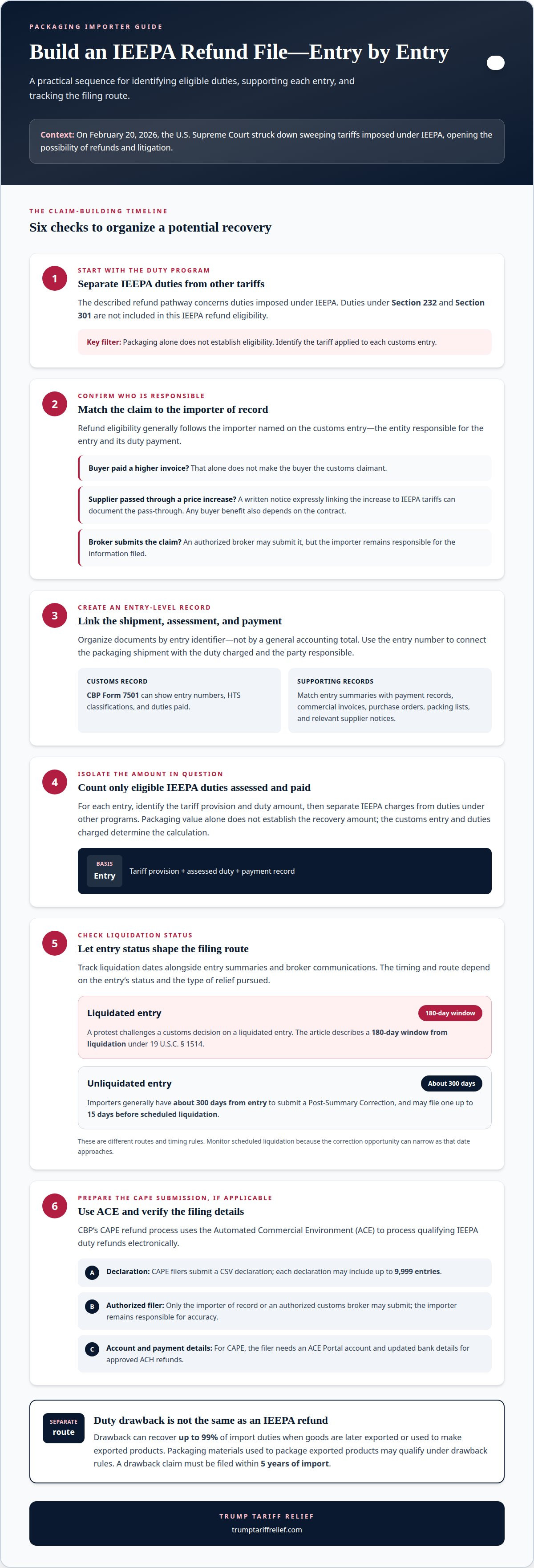
A tariff refund for packaging material importers may be possible if the entries carried IEEPA duties and the business was the importer of record. On February 20, 2026, the U.S. Supreme Court struck down sweeping tariffs imposed under IEEPA, opening the possibility of refunds and litigation, according to the Supreme Court of the United States. This does not make every tariff on packaging refundable: Section 232 and Section 301 duties aren’t included in the described IEEPA refund eligibility.
The challenge is often more than identifying a tariff payment. Packaging imports can involve multiple entries, suppliers, and records. A refund claim depends on linking duties paid to the customs entry and the importer responsible for it.
This guide explains which importers may qualify, how the tariff program and entry status affect eligibility, and which customs records can support a claim. It also covers how entry summaries, payment records, and supplier notices help show what was charged and who bore the cost, so you can assess a potential recovery.
Key Takeaways
- Separate duty programs by customs entry to identify which payments may fall within a refund pathway.
- Build the claim around records that connect the entry, tariff charges, and responsible importer.
- Use entry summaries and supporting payment or supplier records to clarify what was assessed and who bore the cost.
- Understand how entry status and the filing process shape the next step, from organizing documents to submitting a claim.
Are Tariffs Refundable for US Importers in 2026?
Some US importers can pursue refunds for duties imposed under IEEPA, but eligibility depends on the tariff program and customs entries. On February 20, 2026, the U.S. Supreme Court struck down sweeping tariffs imposed under IEEPA, opening the possibility of refunds and litigation, according to the Supreme Court of the United States.
Packaging alone does not determine eligibility. The key questions are which duties applied, who was the importer of record, and whether the relevant entries have liquidated.
Importer-of-Record Refund Eligibility
The importer of record is the entity responsible for a customs entry and its duty payment. This matters because tariff refund eligibility generally follows the importer named on the entry, not every business that ultimately absorbed the cost.
If a supplier raised packaging prices because of IEEPA duties, the buyer’s higher invoice alone does not make it the customs claimant. A written supplier notice expressly linking price increases to IEEPA tariffs can document the pass-through. Whether a buyer can benefit also depends on its contract with the importer or logistics provider. An authorized broker may submit a claim, but the importer remains responsible for the information filed.
Refunds Compared With Other Relief
An IEEPA tariff refund seeks recovery of duties assessed under the tariff authority addressed by the Supreme Court decision. A protest challenges a customs decision on a liquidated entry. A tariff exclusion, by contrast, concerns whether specified goods receive different tariff treatment; it is not the same refund route.
Duty drawback is separate: it can recover up to 99% of import duties when goods are later exported or used to make exported products. Packaging materials used to package exported products may qualify under drawback rules. A drawback claim must be filed within 5 years of import.
Recovery Amounts and Refund Calculations
There is no single refund amount for packaging imports. The calculation starts with IEEPA duties actually assessed and paid on eligible entries, separating those charges from duties under other tariff programs.
For each entry, the relevant figures are the tariff provision, duty amount, and entry status. Liquidated entries can involve a protest route, with a 180-day window from liquidation under 19 U.S.C. § 1514. Unliquidated entries follow a different process. Packaging value alone doesn’t establish recovery; the customs entry and duties charged determine the calculation.
Documentation for import duty refund claims
A well-organized refund file links each packaging shipment to its customs entry, tariff assessment, and duty payment. These records also help track the claim as an entry’s liquidation status changes.
Required Claim Documentation
Claim documentation is the set of records that supports the entry, duty amount, and party seeking recovery. For packaging imports, CBP Form 7501 can show entry numbers, HTS classifications, and duties paid.
Match each entry summary with payment records, commercial invoices, and supplier notices attributing price increases to IEEPA tariffs. Together, these records help distinguish customs duties assessed on an entry from a supplier’s later price adjustment. Keep the original documents organized by entry identifier instead of relying on a general accounting total.
Refund Documentation Deadlines
Documentation deadlines depend on the entry’s liquidation status and the relief route. For unliquidated entries, importers generally have about 300 days from entry to submit a Post-Summary Correction, and may file one up to 15 days before scheduled liquidation.
That timing makes liquidation tracking essential: a correction opportunity can narrow as the scheduled date approaches. Preserve entry summaries, payment records, and broker communications together, so the supporting file is ready for the applicable filing. For drawback claims, the filing deadline is 5 years from import.
Applicable Customs Rules and Forms
CBP’s CAPE refund process uses the Automated Commercial Environment, or ACE, to process qualifying IEEPA duty refunds electronically. The entry summary, CBP Form 7501, helps identify the entries and assessed duties relevant to the claim.
CAPE filers submit a CSV declaration, and each declaration may include up to 9,999 entries. Only the importer of record or an authorized customs broker may submit it; the importer remains responsible for the accuracy of broker-submitted information. These are the key forms and system requirements for this IEEPA refund route.
Packaging Tariff Refund Claim Steps
Organize the claim around each entry, not just the packaging invoice. Identify the tariff provision, entry number, duty payment, and liquidation status, then gather the entry summaries and supporting invoices or supplier notices that explain the charges.
Errors in entry identifiers, tariff categories, or duty totals can undermine a claim. A broker’s submission does not transfer the importer’s responsibility for accuracy. For CAPE, the filer also needs an ACE Portal account and updated bank details for approved ACH refunds. A clear overview of the customs refund process can help explain how documentation supports filing.
Customs records and supporting documentation
A useful customs record set links each packaging purchase to its import entry and duty assessment. The importer-of-record identity matters because refund eligibility generally follows the entity responsible for the entry and payment.
Use the entry number to organize the file, then link the customs record to commercial invoices, purchase orders, packing lists, and payment records. For example, a supplier invoice may describe cartons or film, while a packing list ties those goods to a shipment. This cross-reference helps distinguish packaging materials from other goods covered by the same entry.
Commercial records support the entry trail, but they do not replace it. A company ledger may show a combined duty payment, while customs records identify individual entries and tariff charges. Clearly link the ledger amount to the entry summary and payment evidence. Supplier documents can also clarify product descriptions or price adjustments, particularly when invoices use different item codes.
Entry status shapes which record matters next. Phase One of the CAPE process includes certain unliquidated entries and entries liquidated within 80 days of the CAPE submission date. A reliable status record helps separate entries in that window from others, so the filing can use the appropriate entry data.
CBP’s ACE system processes qualifying IEEPA refunds through CAPE. Keep a working schedule of entry numbers, tariff provisions, duty amounts, liquidation status, and supporting document locations. This gives the filer a consistent record for preparing the CAPE declaration and resolving differences between customs and accounting data.
Keep original documents alongside any corrected versions. If a broker’s filing uses revised entry details, retain the earlier record and note why it changed. Customs and Border Protection places responsibility for submitted information on the importer, even when an authorized broker submits the declaration. A traceable record helps explain what changed and why.
How do importers claim a refund for tariffs paid on packaging materials?
A tariff refund for packaging material importers begins with qualifying IEEPA duties and the customs entries where they were assessed. The filing must identify eligible entries and match the requested recovery to duties actually charged, rather than treating every packaging-related cost as refundable.
The process depends on who may file, which entries qualify, and where CBP can send an approved refund. Only the importer of record or an authorized customs broker may submit a CAPE Declaration. The importer remains responsible for the accuracy of information filed by a broker.
- Sort the entries. Separate IEEPA duties from Section 232, Section 301, or other charges, then group relevant entries by liquidation status.
- Prepare the declaration. CAPE filers submit a CSV file through ACE. The declaration connects entry details with the IEEPA duty amounts claimed.
- Set up payment details. CBP requires an ACE Portal account and updated bank information for approved refunds by ACH. CBP began issuing refunds electronically through ACH on February 6, 2026, subject to limited exceptions.
CBP doesn’t charge a fee to process tariff refunds. After CAPE acceptance, valid IEEPA refunds are generally issued within 60 to 90 days. That timeframe runs from acceptance, not from the date packaging was purchased or the customs entry was made.
For a tariff refund for packaging material importers, packaging invoices can link products to shipments, but the customs entry establishes the duty assessment. A supplier’s price increase is a separate cost record, not proof that the importer paid IEEPA duties on a particular entry. Keeping the records separate helps prevent unrelated charges from being included in the calculation.
Before submitting a declaration, map the IEEPA refund process and identify the eligible entries and filing requirements.
Trump Tariff Relief: IEEPA Tariff Refund Recovery
Trump Tariff Relief helps importers assess IEEPA refund eligibility and organize the records needed to pursue recovery. If packaging imports involve multiple entries, unclear liquidation status, or duties spanning different tariff programs, a structured review can clarify which records support a claim and which filing path applies.
Trump Tariff Relief’s Tariff Eligibility Assessment reviews relevant entries, and Customs Documentation Management organizes supporting customs records. IEEPA Tariff Refund Recovery supports the claim process through government filings. This assistance is useful when your team needs help connecting entry summaries, duty payments, and tariff classifications in a consistent record.
The service operates on a contingency-fee basis: there are no upfront costs, and payment is due only if a refund is successfully recovered. Contact Trump Tariff Relief to discuss your packaging import entries and documentation.
Turn your entry records into a clear next step
For a tariff refund for packaging material importers, assess the specific entries instead of relying on total packaging spend. A focused review can show how tariff codes, importer-of-record details, and customs records fit together, helping your team decide which recovery path to pursue and where documentation needs attention.
That assessment also gives finance and trade teams a shared basis for decisions. Instead of treating supplier price increases and customs duties as one cost, they can distinguish the amounts tied to import entries and identify the records supporting each position. The individual entries and their status determine what action makes sense.
Take the next step with a focused review of your import records. Discuss your packaging tariff refund options with Trump Tariff Relief and move forward with a clearer recovery strategy.
Frequently Asked Questions
Who is eligible to file a tariff refund claim?
The importer of record may file a tariff refund claim, or an authorized customs broker may submit it on the importer’s behalf. The importer remains responsible for information in a broker-filed submission. If your company bought packaging from a domestic supplier but was not named on the customs entry, whether it can benefit depends on its contract with the importer or logistics provider.
Can I still get a refund on entries that have already liquidated?
Liquidation doesn’t automatically close every recovery route. In the United States, an importer may protest a liquidated entry under 19 U.S.C. § 1514, generally within 180 days from liquidation. Use the liquidation date, not the packaging invoice date, to assess that window. A useful first step is to match each liquidation notice to the entry number and duties being challenged.
How can I prepare for a potential refund of IEEPA duties?
Reconcile broker entry records against your accounting ledger so each payment can be traced to an entry. Keep entry summaries, commercial invoices, transportation documents, and duty statements together, preserving corrected versions alongside the originals. If a supplier issued a written notice linking a price increase to IEEPA tariffs, retain it separately from customs payment records: it documents pass-through, not the entry assessment.
What About Older or Different Entries?
Older entries and entries under other tariff programs need separate treatment. Eligibility depends on the tariff provision, entry date, and liquidation status. For drawback, the claim deadline is 5 years from import when goods are exported or used to make exported products. For liquidated entries, the protest period runs from liquidation, so an older import date alone doesn’t establish whether a protest remains available.
What if the tariff was passed through by a supplier?
A supplier’s price increase does not by itself make the buyer the customs claimant. A written notice expressly linking the increase to IEEPA tariffs can help document that the cost was passed through. If your business was not the importer of record, whether it benefits from a recovery depends on its contract with the importer or logistics provider. Keep the agreement and supplier notice connected to the relevant purchases.
Which shipments currently qualify?
Packaging shipments may qualify when their customs entries carry eligible IEEPA duties; packaging type alone doesn’t decide eligibility. Separate IEEPA charges from Section 232, Section 301, and antidumping duties, which aren’t part of this recovery pathway. CAPE’s first phase includes certain unliquidated entries and entries liquidated within 80 days of the CAPE submission date. Entry details and status determine whether a shipment fits.
Ready to find out what your business may be owed?
Check My Eligibility