
Did you know that U.S. Customs collected approximately $166 billion in IEEPA duties from over 330,000 importers before the Supreme Court finally invalidated these tariffs in February 2026? It's a staggering sum of capital that belongs back in the hands of American businesses. However, the window for recovery is narrow, and the new CAPE system requires precise tariff refund claim verification to avoid immediate rejection. If you're feeling overwhelmed by documentation requirements or concerned about potential offsets, you aren't alone.
You need a clear, low-risk path to reclaim your capital without the fear of government audits or predatory scams. This article provides the roadmap you need to navigate the Consolidated Administration and Processing of Entries tool and verify your eligibility before critical deadlines expire. We'll examine the specific requirements for Phase 1 entries, the mechanics of the automated validation process, and the exact steps to ensure your ACE portal data is ready for a successful submission.
Key Takeaways
- Understand why the Supreme Court’s invalidation of IEEPA tariffs creates a fleeting window for your business to reclaim significant capital and right a financial wrong.
- Learn how the CAPE system automates duty removal and how 19 U.S.C. § 1505(b) mandates that the government pays you interest on every dollar recovered.
- Discover why internal accounting records are often insufficient and how to use the ACE portal for the "ground-truth" data required for accurate tariff refund claim verification.
- Identify critical red flags to distinguish legitimate trade experts from predatory "solar cowboys" targeting the $166 billion refund pool.
- Explore the "Triple Verification" framework to ensure your recovery strategy is legally sound, data-compliant, and shielded from future government audits.
What is Tariff Refund Claim Verification and Why is it Urgent?
The era of unchecked executive tariff authority has ended. Following the February 2026 Supreme Court decision in Learning Resources, Inc. v. Trump, the legal landscape for American importers has shifted from passive compliance to active recovery. At its core, tariff refund claim verification is the rigorous process of cross-referencing your internal Importer of Record (IOR) data with the specific entries invalidated by the court's ruling. This isn't a mere administrative task; it's a high-stakes financial audit designed to reclaim capital that was collected without proper statutory authority.
The financial scale of this opportunity is unprecedented. U.S. Customs and Border Protection (CBP) collected approximately $166 billion in IEEPA duties from over 330,000 importers across more than 53 million individual entries. For many businesses, these funds represent a significant portion of their operating capital that has been tied up in federal accounts for years. The launch of the CAPE system in April 2026 provides the official channel for these refunds, but the burden of proof rests entirely on the importer. Without precise verification, your claim faces immediate rejection by an automated system that demands perfect data alignment.
The Legal Foundation of IEEPA Refunds
The Supreme Court's ruling established that the executive branch overstepped its bounds by using emergency powers to impose broad-based trade barriers. This decision created a statutory obligation for the CBP to refund excess moneys collected under these invalidated orders. The International Emergency Economic Powers Act (IEEPA) is the specific federal law that was improperly cited to justify these duties, and it now serves as the cornerstone for your business's legal right to financial restoration. Understanding this foundation is the first step in asserting your claim for the capital your company is owed.
The Consequences of Delayed Verification
Urgency is dictated by the calendar and the law. While the CAPE system offers a streamlined path, the traditional three-year statute of limitations for tariff protests remains a formidable barrier. Every day of delay brings you closer to the permanent forfeiture of your capital. Once these windows close, the legal right to protest or claim a refund expires, and the funds are permanently absorbed by the U.S. Treasury. Engaging in tariff refund claim verification immediately ensures that your entries are flagged and protected before these rigid deadlines pass. Learn more about the IEEPA ruling and how the current timeline affects your specific port entries.
The Mechanics of CAPE Validation and 19 U.S.C. § 1505(b)
The Consolidated Administration and Processing of Entries (CAPE) system represents a significant shift toward the automation of trade justice. Launched on April 20, 2026, this tool is the exclusive channel for importers to request the return of unlawfully collected IEEPA duties. The system's primary function is tariff refund claim verification, where it cross-references your submitted "CAPE Declaration" against the government's internal ACE portal records. If the data doesn't align perfectly, the claim is rejected before a human ever sees it. This automated gatekeeper is designed for efficiency, but it's also a barrier for those with incomplete or messy data sets.
The legal weight behind these refunds comes from 19 U.S.C. § 1505(b), which mandates that the government refund "excess moneys deposited" with interest. For the quarter beginning April 1, 2026, the interest rate for overpayments is 5% for corporations and 6% for non-corporations. This interest isn't a bonus; it's a statutory right. Once your claim passes the initial verification, a 30-day interest clock begins. This creates a rare scenario where the government is financially incentivized to process your refund quickly to avoid compounding its own interest expenses.
The CAPE Declaration Process
A CAPE declaration is a specialized file that verifies the format and entry numbers of your claim. During Phase 1, which began in April 2026, the system specifically targets unliquidated entries or those within 80 to 90 days of their liquidation date. Verification often fails because of simple data mismatches, such as incorrect Importer of Record (IOR) numbers or entry dates that fall outside the invalidated IEEPA window. If you're unsure if your entries have already been liquidated, it's vital to see how our recovery process identifies eligible entries before you attempt to file.
Government Offsets and Claim Obstacles
One of the most significant risks during the verification phase is the "government offset." CBP acts as both the debtor and the debt collector. If your company has any outstanding customs bills, penalties, or even "bills in progress," the government will likely subtract those amounts from your IEEPA refund before you see a single dollar. Verifying your "clean" status in the ACE portal is a mandatory prerequisite. Additionally, if your company filed prior protests on these entries, the CAPE system might flag them as duplicates. You must reconcile these existing legal actions with the new CAPE filing to ensure your tariff refund claim verification doesn't stall in a bureaucratic loop. For businesses dealing with more extensive liabilities, Fridman Legal provides professional debt relief strategies to help stabilize your financial position.
Internal Audit: Verifying Your Importer of Record (IOR) Data
Relying on your internal accounting software for tariff refund claim verification is a dangerous gamble. While ERP systems like SAP or Oracle are excellent for tracking inventory and sales, they rarely capture the granular customs data required by the CAPE system. Standard software treats tariffs as a static cost of goods sold. It doesn't have the logic to flag entries that suddenly became illegal in February 2026. To secure your recovery, you must bridge the gap between your internal books and the "ground-truth" data found only in the Automated Commercial Environment (ACE) portal.
The ACE portal is the only platform that matters for this audit. It contains the raw data that CBP will use to validate your CAPE declaration. You must identify the specific HTS codes impacted by the Supreme Court ruling, particularly those that fell under the broad IEEPA designations. Many of these goods were previously categorized under "List 3" and "List 4a" during the trade wars of the early 2020s. Verifying which imports qualify requires a surgical look at your entry history to ensure you aren't accidentally claiming Section 301 duties that remain in effect, as this could trigger unwanted scrutiny from CBP auditors.
Essential Documentation for Verification
Your primary tool for verification is CBP Form 7501, the Entry Summary. This document serves as the ultimate proof of duty payment and confirms the Country of Origin data, which must align perfectly with IEEPA criteria. If you have missing or incomplete customs records from the 2024-2025 period, you can't simply guess or use estimates. You need to pull your IOR data directly from ACE to ensure every entry number in your CAPE declaration is accurate. This level of precision is reinforced by recent CBP regulations on electronic refunds, which emphasize the transition to automated, data-driven recovery processes.
Quantifying the Recovery Opportunity
Calculating your potential refund involves more than just adding up duty payments. You must also account for the statutory interest mandated by 19 U.S.C. § 1505(b). Interest accrual makes early verification more profitable because the government's obligation grows with every passing quarter. For the quarter beginning April 1, 2026, the interest rate for overpayments is 5% for corporations and 6% for non-corporations. It's also vital to differentiate between standard duty drawback and IEEPA refund eligibility. While duty drawback depends on the re-exportation of goods, IEEPA recovery is a full refund of unlawfully collected capital, regardless of whether your goods were sold domestically or exported. If you need assistance navigating these categories, our FAQ page provides further clarity on eligibility distinctions.
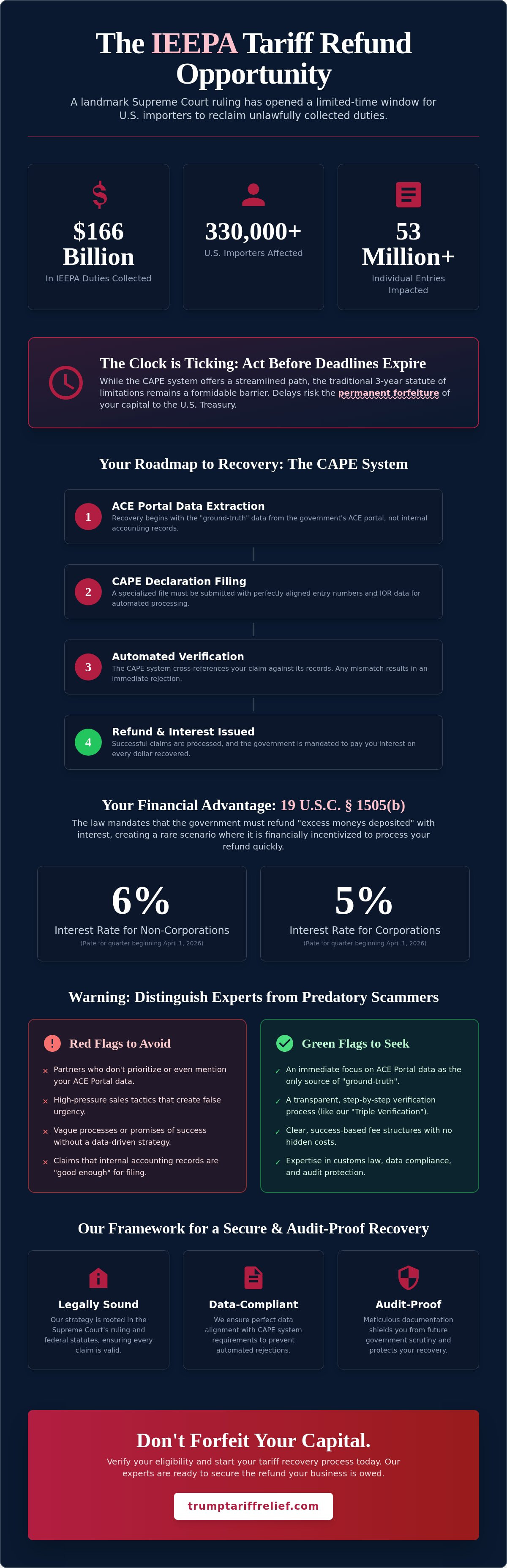
Red Flags: Verifying the Legitimacy of Recovery Partners
The announcement that $166 billion in IEEPA duties is eligible for recovery has created a modern-day gold rush. While this is a massive win for importers, it has also attracted "solar cowboys" and illegitimate actors who lack any background in trade or customs law. These opportunistic firms often pivot from unrelated industries to capitalize on the high-stakes 2026 recovery window. Protecting your business requires more than just submitting a claim. It requires a partner who understands that tariff refund claim verification is a legal and technical process, not just a data-entry task.
A legitimate recovery partner must demonstrate a deep, verifiable track record in navigating the complexities of the U.S. Customs and Border Protection (CBP) bureaucracy. They should be able to explain the specific mechanics of the CAPE system and the implications of the Learning Resources, Inc. v. Trump ruling without resorting to vague buzzwords. If a consultant cannot articulate how they will protect your company from future government offsets or audits, they are a liability, not an ally. Your data is your most sensitive asset. Verifying the security of the data-sharing process is non-negotiable; legitimate firms use secure, encrypted portals rather than requesting documents via standard email.
Warning Signs of Tariff Recovery Scams
CBP has issued explicit warnings regarding phishing scams and fraudulent third-party services. You should immediately disqualify any consultant who exhibits the following behaviors:
- Requests for your ACE portal login credentials or banking information via email or social media.
- Pressure to pay "processing fees," "filing costs," or "administrative deposits" before any capital is recovered.
- Vague references to "secret" government programs or "exclusive" insider connections rather than citing the IEEPA ruling and CAPE system.
- Claims that they can process refunds through channels other than the official ACE portal.
The Contingency Fee Advantage
The most reliable litmus test for a legitimate trade recovery firm is a "no upfront cost" model. A success-based fee structure ensures the consultant’s interests are perfectly aligned with yours. In the trade recovery industry, a contingency model means the firm takes on the entire financial risk of the audit, verification, and filing process. They only receive a percentage of the capital once it is actually returned to your accounts. This assertive approach demonstrates confidence in their own results and protects your bottom line from unnecessary expenses. Learn how our contingency model works to provide a low-risk path to reclamation.
Don't leave your capital in the hands of unverified actors. Secure your refund by partnering with a team that prioritizes transparency and results. Start your recovery today with a professional Tariff Eligibility Assessment to see exactly what your business is owed.
Securing Your Refund with Trump Tariff Relief
Reclaiming your capital isn't just about filing paperwork; it's about forcing a massive bureaucracy to correct a multi-billion dollar error. Trump Tariff Relief stands as an assertive advocate for American importers, positioning itself as a high-performing partner in a high-stakes environment. We don't just "submit" claims. We prosecute them through a rigorous "Triple Verification" framework that covers the legal, data, and compliance pillars of every entry. By prioritizing this elite level of tariff refund claim verification, we eliminate the common data mismatches that lead to automated rejections within the CAPE system.
Our specialized focus on IEEPA recovery makes us a powerful ally. We aren't a general customs brokerage distracted by routine filings; we're a recovery engine built for one purpose: returning your capital. We handle the heavy lifting, from navigating the ACE portal to reconciling complex entry summaries. This allows your leadership team to focus on core business operations while we manage the technical and legal complexities of the 2026 recovery window. We move with the professional urgency required to meet strict external deadlines, ensuring no dollar is left behind.
The Path from Verification to Restoration
Once we verify your eligibility, our team moves immediately into the execution phase. We manage the entire documentation trail, including the reconciliation of CBP Form 7501 Entry Summaries and the final CAPE Declaration filing. We don't just aim for the principal duties. We ensure your business receives the maximum statutory interest entitled by law. With current rates at 5% for corporations and 6% for non-corporations as of the quarter beginning April 1, 2026, the interest alone can represent a significant financial restoration. We monitor the 30-day interest clock to ensure CBP processes your verified claims without unnecessary bureaucratic delay.
Get Started with a Preliminary Assessment
The path to reclamation starts with a low-friction preliminary assessment. This audit identifies your total potential recovery amount and flags any existing government offsets that could complicate your filing. Our expert team is the most reliable partner for 2026 filings because we've built our internal systems specifically to align with the CAPE environment. Don't let your capital sit in government accounts while the statute of limitations runs out. Read our FAQ for more details on how we can accelerate your IEEPA recovery and right this financial wrong today.
Reclaim Your Capital Before the Window Closes
The invalidation of IEEPA tariffs has opened a historic financial door for American importers, but the complexity of the CAPE system means you can't afford to wait. Successful recovery hinges on rigorous tariff refund claim verification that aligns your internal records perfectly with the government's ACE portal data. Every day your capital remains in federal accounts is a day it isn't working for your business. By leveraging statutory interest and the current legal precedent, you can turn a past trade burden into a present-day capital injection.
Trump Tariff Relief offers a specialized, assertive approach to IEEPA and Section 301 recovery. Our team of experts takes on the heavy lifting of documentation and filing with no upfront costs or hourly billing. Because we operate on contingency-based fees, you only pay if we successfully recover your money. This low-risk partnership ensures your interests are always the priority. It's time to stop letting bureaucracy hold your funds hostage.
Start Your Free Tariff Eligibility Assessment Now
Righting this financial wrong starts with a single step. We're ready to help you win back what's yours.
Frequently Asked Questions
Is the China tariff refund program real or a scam?
The IEEPA refund program is a legitimate federal recovery process established after the February 2026 Supreme Court ruling invalidated specific trade barriers. It's distinct from the Section 301 tariffs on Chinese goods, which remain in effect. While the program is real, you must stay vigilant against phishing scams. Official claims are only processed through the ACE portal, and legitimate partners will never ask for your banking credentials via email or social media.
How much does it cost to verify my tariff refund claim?
Verification of your claim shouldn't require upfront capital or hourly consulting fees. Legitimate recovery firms operate on a contingency basis, meaning they only receive a percentage of the capital once it's successfully returned to your accounts. This model ensures the firm takes on the financial risk of the audit. If a consultant demands "filing fees" or "administrative deposits" before identifying your eligible entries, it's a significant red flag.
What is the deadline for filing an IEEPA tariff refund claim in 2026?
Deadlines are determined by the liquidation date of each specific entry and the three-year statute of limitations for customs protests. Phase 1 of the CAPE system, which launched on April 20, 2026, focuses on unliquidated entries and those within 90 days of their liquidation date. Because these windows are rigid, immediate action is necessary to ensure your oldest entries don't permanently forfeit their eligibility for a full refund with interest.
Can I verify my own tariff refund eligibility through the ACE portal?
Importers can pull raw data reports from the ACE portal, but translating those files into a successful filing is a technical challenge. Effective tariff refund claim verification requires cross-referencing thousands of entry lines against the specific HTS codes invalidated by the court. Most internal accounting systems lack the trade-specific logic to identify which entries qualify under the IEEPA ruling versus those still subject to Section 301 duties.
What documents do I need to provide for claim verification?
You need your Entry Summaries, specifically CBP Form 7501, and your Importer of Record (IOR) number. These documents provide the "ground-truth" data, including the country of origin and the specific duty rates paid. If your internal records are incomplete for the 2024 to 2025 period, we can pull this data directly from the ACE portal to ensure your CAPE declaration matches the government's records perfectly before submission.
How long does the verification and refund process typically take?
The initial tariff refund claim verification through the CAPE tool happens almost instantly as the system checks for formatting and entry validity. However, the actual distribution of funds depends on CBP's processing queue. Once your claim is accepted, a 30-day interest clock begins under 19 U.S.C. § 1505(b). This statutory requirement incentivizes the government to process verified claims quickly to avoid paying additional interest on the "excess moneys deposited."
Does my business still qualify if we use a customs broker?
Yes, your business qualifies because the refund belongs to the Importer of Record, not the broker who facilitated the entry. While customs brokers handle daily compliance and logistics, they rarely specialize in retroactive legal recovery programs. Using a specialized recovery partner doesn't interfere with your ongoing brokerage relationship. It simply ensures you have an advocate focused solely on reclaiming capital that was collected under an invalidated legal authority.
What happens if the government denies my verified claim?
If a claim is denied, it's typically due to a data mismatch or an existing government offset, such as an unpaid customs bill. You'll receive a notification through the ACE portal explaining the rejection. At that point, you have a narrow window to reconcile the data and refile the claim. If the denial is based on a legal disagreement, you may need to pursue a formal protest or litigation through the Court of International Trade.
Ready to find out what your business may be owed?
Check My Eligibility