
The U.S. Supreme Court’s February 2026 decision to invalidate IEEPA-based tariffs has unlocked a recovery pool expected to exceed $100 billion, yet most of that capital remains trapped in federal accounts rather than on retail balance sheets. For years, your margins have been squeezed by aggressive trade policies, and the prospect of fighting for a section 301 tariff refund for retailers often feels like another expensive bureaucratic hurdle. You've likely watched your operating capital vanish into contested duties while facing high hourly legal fees that offer no guarantee of a return.
We understand that your internal teams are already stretched thin and don't have the bandwidth to navigate the new CAPE system or manage complex CBP documentation. This guide will show you exactly how to reclaim millions in overpaid Section 301 and IEEPA tariffs using a success-based recovery model that eliminates all upfront financial risk. You'll discover a hands-off, expert-led path to righting these financial wrongs, ensuring your retail business secures the necessary cash flow to thrive through the 2026 fiscal year and beyond.
Key Takeaways
- Discover how the success-based model eliminates out-of-pocket risk by shifting the financial burden of research and filing to trade experts.
- Learn why the current regulatory landscape makes a section 301 tariff refund for retailers a high-priority asset for improving 2026 fiscal year cash flow.
- Contrast the total cost of ownership between traditional hourly legal fees and contingency recovery to protect your budget from non-guaranteed outcomes.
- Identify the critical phases of the reclamation roadmap, from initial eligibility assessment to automated data extraction through the CBP’s latest systems.
- Gain an "insider" advantage by leveraging a specialized team that navigates complex bureaucracy to restore capital previously tied up in contested duties.
What is Contingency-Based Duty Recovery for Retailers?
Contingency-based duty recovery is a results-oriented financial strategy designed to reclaim capital lost to regulatory overreach. In this model, trade experts handle the forensic auditing and labor intensive filing required to secure a section 301 tariff refund for retailers. Instead of paying for hours billed, you pay for capital recovered. A success fee is only earned when the refund check is in your hands. This differs fundamentally from standard administrative tasks. While customs documentation management focuses on ongoing compliance and clerical accuracy; recovery is about legal advocacy and retroactive justice.
The core of this partnership is the "No-Win, No-Fee" promise. Retailers have historically been wary of pursuing refunds because of the high costs associated with trade litigation and the uncertainty of the outcome. By adopting a success-based model, the financial risk shifts entirely to the service provider. If the government doesn't issue a refund, the retailer pays nothing. This arrangement ensures your interests are perfectly aligned with those of your recovery partner. It's a low-risk, high-reward approach to restoring your 2026 fiscal year margins.
The Rise of IEEPA Tariff Refunds in the Retail Sector
The February 20, 2026, Supreme Court ruling changed the landscape for American importers. By invalidating tariffs imposed under the International Emergency Economic Powers Act (IEEPA), the court created a massive window for financial restoration. Most standard customs brokers lack the specialized legal depth to handle these complex claims. They are built for logistics, not for challenging federal trade policy. The scale of this opportunity is staggering. With billions in contested List 3 and List 4a duties under Section 301 of the Trade Act of 1974, retailers finally have the legal leverage to reclaim what was never legally theirs to pay. This isn't just about accounting; it's about righting a financial wrong that has hampered retail growth for years.
Success-Based Models vs. Traditional Consulting
The industry is witnessing a decisive shift from expensive legal retainers to performance-driven trade advocacy. Traditional consultants often charge for "assessment packages" that provide a roadmap but no actual capital. If a firm requires payment before they've secured your section 301 tariff refund for retailers, they aren't truly invested in your success. Contingency models democratize access to elite trade expertise. Now, mid-sized retailers can leverage the same high-level litigation strategies as global conglomerates without draining their operating budgets on "dead-end" research. You deserve a partner that only wins when you win.
The Financial Mechanics of the Success-Fee Model
The success-fee model operates on a simple, transparent principle: professional trade experts only receive compensation when they successfully secure a section 301 tariff refund for retailers. This contingency fee is calculated as a predetermined percentage of the actual capital recovered from U.S. Customs and Border Protection (CBP). By tying compensation to results, the financial burden of forensic research, data extraction, and bureaucratic filing shifts entirely from your balance sheet to the recovery partner. It’s a low-risk partnership that prioritizes your liquidity while ensuring every eligible entry is identified and contested.
Transparency is the cornerstone of this agreement. A comprehensive success-fee arrangement covers the entire lifecycle of the claim, including historical entry reviews, legal analysis of List 3 and List 4a eligibility, and the management of the new CAPE refund system. Because the consultant bears all the "sunk cost" risk, they are naturally incentivized to dig deeper into your import history. Unlike traditional models, this approach ensures that no potential refund is left on the table due to clerical oversight or lack of time.
Zero Upfront Cost: Protecting Retail Working Capital
In the 2026 fiscal year, preserving working capital is vital for inventory management and supply chain expansion. Traditional legal models require significant upfront retainers and hourly billing, which often forces retail executives to seek complex budget approvals for uncertain outcomes. Contingency recovery bypasses these internal hurdles. It effectively converts past tariff expenses into future liquid assets without requiring a single dollar of initial investment. This allows your team to focus on growth while trade insiders handle the heavy lifting of reclaiming duties invalidated by the February 2026 Supreme Court ruling.
Incentive Alignment in Duty Reclamation
There is a fundamental difference between simply filing a protest and winning a recovery. Hourly consultants get paid regardless of the outcome, which can lead to "dead-end" research that drains your resources. In contrast, a success-based partner is motivated to maximize the total refund. They utilize specialized data mining to uncover overlooked opportunities within the U.S. Trade Representative's Section 301 investigations and historical IEEPA-based filings. This alignment of interests ensures that your partner works aggressively for every dollar, providing a level of advocacy that standard customs brokers simply aren't equipped to offer. To see how these mechanics apply to your specific entries, you can review how the recovery process works in detail.
Contingency Fees vs. Hourly Legal Rates: A Risk-Benefit Analysis
The Total Cost of Ownership (TCO) for a section 301 tariff refund for retailers varies wildly depending on the service model you select. Traditional legal firms rely on hourly retainers; a model that creates a significant financial imbalance. You pay for every email, every phone call, and every hour of research regardless of whether a check ever arrives. In contrast, success-based recovery aligns the firm’s revenue directly with your results. If there's no refund, there's no cost. This removes the risk of "dead-end" research where retailers spend thousands in legal fees only to be told their claims are ineligible.
Specialized consultancies bridge the "Expertise Gap" that general corporate lawyers often can't fill. Trade law is a labyrinth of CBP internal memos and shifting deadlines. Generalists frequently lack the specific technical knowledge to navigate the CAPE system or the historical context of IEEPA-based duty invalidation. Because contingency firms take on the financial risk, they only accept claims they are confident they can win. Securing a section 301 tariff refund for retailers requires this level of tactical precision to avoid government denials and administrative delays.
The Hidden Costs of Hourly Billing in Trade Disputes
Hourly rates create a psychological barrier that prevents retailers from pursuing legitimate tariff recovery for importers. When billable hours threaten to exceed the potential refund value, most businesses walk away and leave millions on the table. The Success Gap is the threshold where the cumulative costs of hourly legal discovery surpass the actual value of the capital restored to the business.
Efficiency through Proprietary Data Mining
Success-based firms utilize specialized technology to audit thousands of import entries in a fraction of the time it takes a manual legal team. This streamlined approach allows for rapid identification of List 3 and List 4a opportunities. Performance-based teams typically maintain higher success rates because their survival depends on their ability to win. They prioritize the most direct path to a government payout, ensuring your 2026 fiscal year cash flow is restored without unnecessary administrative delays.
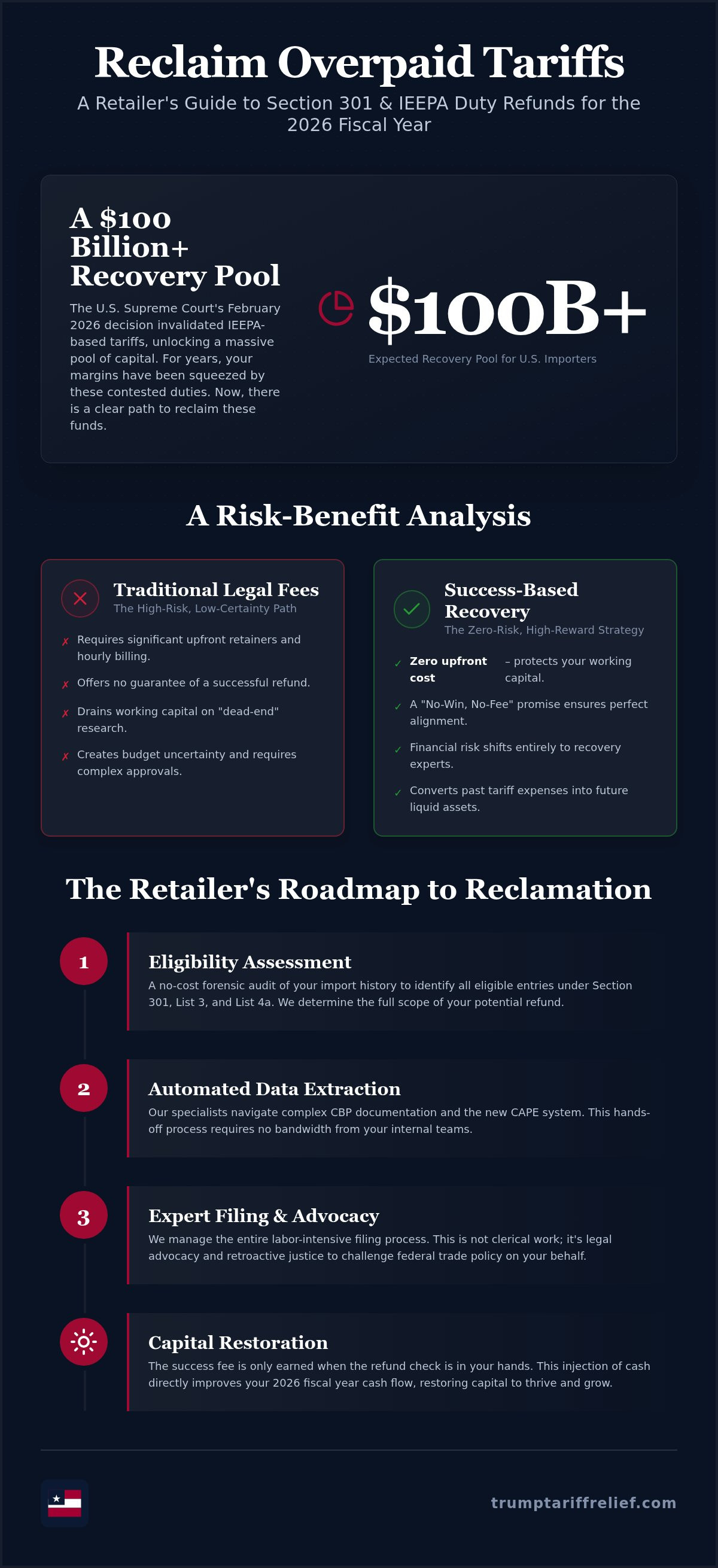
The Retailer’s Roadmap to Tariff Reclamation in 2026
Securing a section 301 tariff refund for retailers is a rigorous, multi-stage operation that requires both forensic data analysis and legal advocacy. It isn't a simple clerical task; it's a strategic effort to reclaim capital that was never legally owed. The path to recovery follows five distinct phases designed to move your claim through the federal bureaucracy with maximum efficiency. This methodical approach ensures that your internal teams remain focused on core operations while trade insiders handle the technical heavy lifting.
- Phase 1: The Tariff Refund Assessment determines the viability of your claims based on historical import volumes and HTS codes.
- Phase 2: Data extraction involves a deep dive into CBP records to identify every eligible entry summary from your past fiscal years.
- Phase 3: Formal filing of the IEEPA or Section 301 protest is submitted to the government, utilizing the latest CAPE system protocols.
- Phase 4: Monitoring the government response requires managing additional documentation requests and navigating federal inquiries.
- Phase 5: Successful recovery concludes with the distribution of the tariff refund directly to your business balance sheet.
The Importance of the Preliminary Assessment
Trade experts audit your historical HTS codes and entry summaries to identify "low-hanging fruit," such as clear-cut List 3 and List 4a overpayments. This stage is critical because it separates viable legal challenges from entries that don't meet the Supreme Court's 2026 invalidation criteria. For a retail executive, a quick "No" during the assessment phase is just as valuable as a "Yes." It prevents your organization from wasting time on ineligible claims and ensures that all efforts are concentrated on high-probability section 301 tariff refund for retailers opportunities.
Navigating the 2026 Statute of Limitations
Time is the greatest enemy of duty recovery. The tariff refund statute of limitations dictates strict windows for filing protests, and missing these deadlines results in a total loss of eligibility. Following the February 2026 Supreme Court decision, the clock began ticking on billions in potential refunds. Waiting until the end of the fiscal year to begin your review is a high-risk gamble. As CBP continues to process a surge of applications through the new automated system, early filers are prioritized for capital distribution. Don't let your capital remain in federal accounts simply because a deadline passed. You can start your recovery journey today by initiating a preliminary recovery assessment to secure your place in the filing queue.
Partnering with Trump Tariff Relief for Financial Restoration
Trump Tariff Relief operates as a high-performing ally for businesses caught in the crosshairs of shifting trade policies. Our specialized focus ensures that we only win when your retail business wins. While the 2026 regulatory environment remains volatile, our team of trade and legal experts provides the steady hand needed to navigate the CAPE system and CBP bureaucracy. We take on the heavy lifting of documentation for the retail and technology sectors, identifying every opportunity for a section 301 tariff refund for retailers. This isn't just a service; it's a strategic partnership designed to reclaim capital that belongs on your balance sheet.
Our "insider" advantage stems from a deep understanding of the intersection between trade law and financial recovery. We don't just file paperwork. We build a persuasive case for restoration based on the February 2026 Supreme Court ruling and the subsequent invalidation of IEEPA-based duties. By leveraging our expertise, you bypass the learning curve of new government portals and avoid the administrative delays that plague unassisted filings. We're motivated by your success, and our results-oriented model reflects that commitment.
Why Choose a Specialized IEEPA Partner?
Standard customs brokers focus on the logistics of today, but they often lack the specialized legal depth required for retroactive litigation. There's a clear distinction between administrative filing and the work of IEEPA recovery specialists. Our experts understand the nuances of the 2026 regulatory shifts and maintain a rigorous commitment to documentation accuracy and government compliance. We specialize in the financial restoration of US retail importers who have been unfairly impacted by contested trade duties. By focusing exclusively on recovery, we identify eligibility patterns that generalists simply miss.
Next Steps: Your Risk-Free Eligibility Check
Starting your recovery journey is a low-friction process that requires zero upfront financial commitment. During your initial contingency-based consultation, we'll outline the specific path for your section 301 tariff refund for retailers based on your historical entry summaries. We know your logistics and finance teams are already stretched thin. That’s why our data extraction process is designed for minimal time commitment from your staff. We act as the active engine of the claim, managing the forensic audit and government protests while you focus on 2026 fiscal growth. The window for these claims is finite. You can start your free eligibility assessment now to ensure your business doesn't leave millions in federal accounts.
Reclaim Your Capital and Restore Your 2026 Margins
The window for financial restoration following the February 2026 Supreme Court ruling is rapidly closing. You've seen how success-based recovery models align your interests with trade experts, removing the "sunk cost" risk associated with traditional hourly legal retainers. By leveraging specialized data mining and insider advocacy, your business can identify every eligible entry summary and bypass the bureaucratic delays of the new CAPE system. Securing a section 301 tariff refund for retailers is the most direct path to injecting millions back into your working capital this fiscal year.
Trump Tariff Relief provides national service for all US retail importers, offering specialized IEEPA and Section 301 expertise with a strict $0 upfront cost guarantee. We manage the entire documentation process, ensuring your logistics and finance teams stay focused on growth while we handle the heavy lifting. It's time to right the financial wrongs of past trade policies and bring your capital home.
Secure your risk-free tariff recovery assessment today and discover how much capital is waiting to be restored to your balance sheet. You've already done the hard work of importing; now let us do the work of winning your refund.
Frequently Asked Questions
Is contingency-based duty recovery legal and legitimate for retailers?
Contingency-based recovery is entirely legal and recognized by U.S. Customs and Border Protection. It's a performance-driven model where the consultant takes on the financial risk of the claim. Following the landmark 2026 Supreme Court ruling that invalidated IEEPA-based tariffs, many retailers are using this model to right financial wrongs. It ensures that businesses don't have to pay upfront legal fees to reclaim capital that was never legally theirs to pay in the first place.
How much does a contingency-based tariff recovery service actually cost?
There are no out-of-pocket expenses or hourly billing rates with this model. The service is funded entirely by a success fee, which is a predetermined percentage of the actual refund secured from the government. If no refund is recovered, you owe nothing. This arrangement eliminates the sunk-cost risk that often stops businesses from pursuing a section 301 tariff refund for retailers. It's a high-reward partnership that protects your current operating budget while targeting past overpayments.
What happens if my Section 301 tariff refund claim is denied?
If a claim is denied by CBP, your business faces zero financial liability. Because we operate on a contingency basis, our team absorbs the costs of the forensic research, data extraction, and filing labor. We only accept claims that we believe have a strong legal foundation based on current trade regulations. This protective structure ensures that your 2026 fiscal year margins aren't further impacted by failed litigation or administrative denials.
How long does the duty recovery process typically take in 2026?
The timeline depends on the complexity of your import history and the current processing speed of the CBP's CAPE system. While the initial eligibility assessment is completed quickly, the formal government review often takes several months. Since the Supreme Court decision in February 2026, there has been a surge in filings. We actively monitor every stage of the roadmap to ensure your capital is restored as efficiently as the federal bureaucracy allows.
Can I still claim a refund if my customs broker says I am not eligible?
Yes, you should still seek a specialized assessment. Customs brokers are logistics experts focused on ongoing compliance, not retroactive trade litigation or IEEPA-based recovery. They often lack the specific legal depth required to identify complex refund opportunities created by the 2026 court rulings. A specialized recovery partner uses proprietary data mining to uncover eligibility that standard brokerage software might overlook. It's always worth a second look to ensure no capital is left behind.
What documents do I need to provide for a contingency-based assessment?
To begin an assessment, we primarily need your historical entry summaries (CBP Form 7501) and a list of HTS codes used for imports from 2024 to 2026. These documents allow us to conduct a forensic audit of your paid duties. If you don't have these records readily available, we can often work with your team to extract the necessary data directly from CBP records. The goal is a low-friction process with minimal time commitment.
Is there a minimum tariff amount required to start a recovery claim?
There's no fixed minimum, but we prioritize claims where the potential recovery justifies the administrative effort for both parties. For mid-sized and large retailers, overpaid duties often reach into the millions across List 3 and List 4a entries. Our initial assessment helps determine if a section 301 tariff refund for retailers is a viable financial asset for your business. We focus on high-probability opportunities that provide a meaningful boost to your 2026 cash flow.
How does the IEEPA Supreme Court ruling affect my current 2026 imports?
The February 2026 Supreme Court ruling specifically invalidated past tariffs imposed under the International Emergency Economic Powers Act. This created a court-ordered refund process for those specific duties. However, your current 2026 imports are likely governed by the administration's pivot to Section 301 of the Trade Act of 1974. Understanding the distinction between these two legal frameworks is essential for accurate documentation. We help you navigate these complexities to ensure both past recovery and current compliance are handled correctly.
Ready to find out what your business may be owed?
Check My Eligibility